Recent Post
Choosing a thermal scope for nighttime use is very different from choosing a simple handheld thermal viewer.
For lawful night hunting, wildlife management, ranch monitoring, security patrols, and perimeter observation, the user often needs more than the ability to detect a heat source.
The more practical questions are:
Can I detect it clearly, follow it smoothly, determine the distance, and use the same compact device without constantly switching between different optics?
That is the idea behind the
LinduNV LDTI006 thermal imaging scope
.
Although its compact size allows it to be used as a handheld thermal viewer, the LDTI006 is fundamentally designed as an all-in-one ranging thermal imaging scope.
It combines a thermal imaging sensor, pulse laser rangefinder, red-dot reference system, and an integrated standard 20 mm mounting base in a 275 g package.
Instead of treating specifications such as 320 × 240, <40 mK and 50 Hz as isolated numbers, let us look at how they fit the actual role of a compact thermal scope.
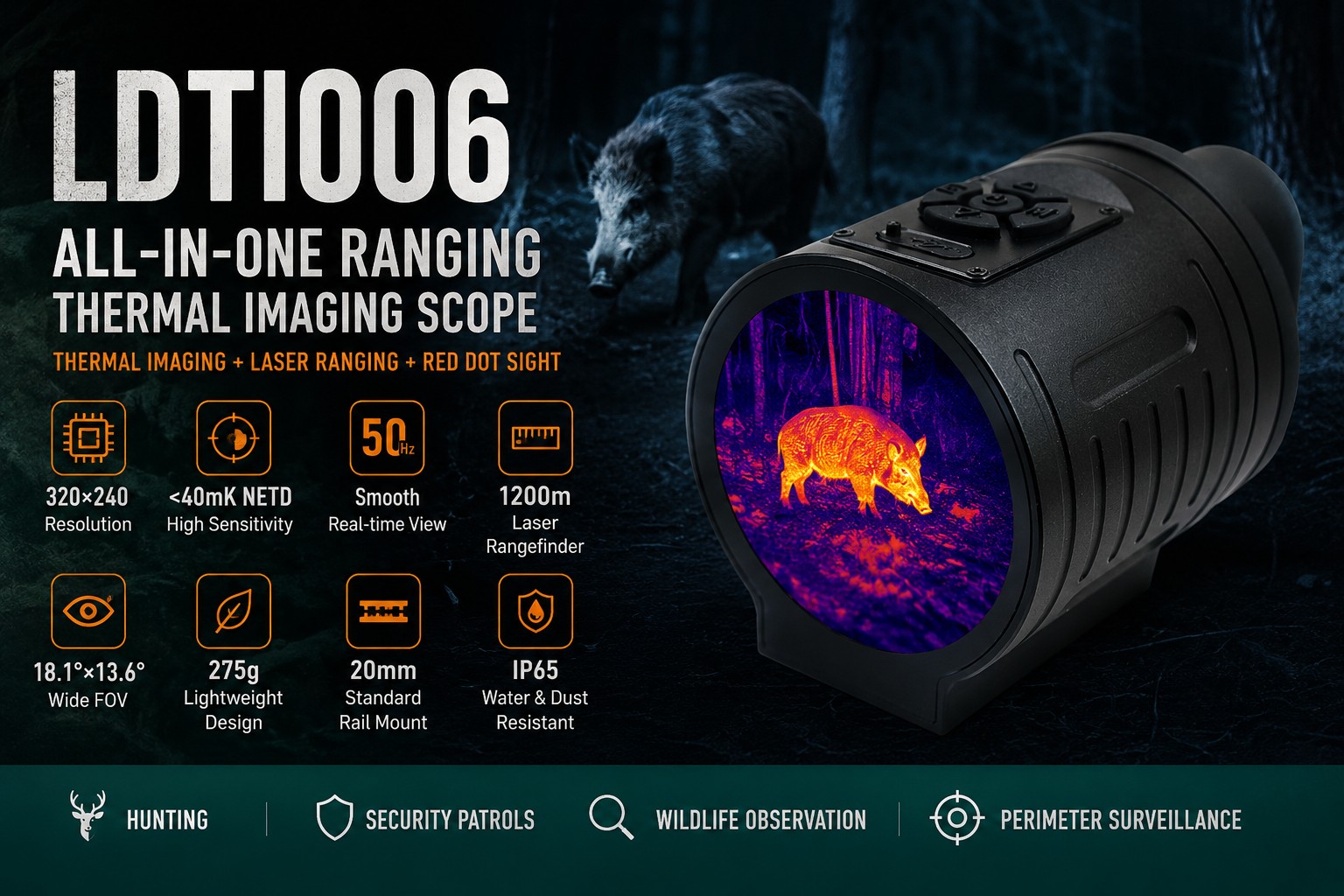
The LDTI006 is not simply a thermal monocular with an extra ranging function attached.
Its system combines three primary functions:
The housing also incorporates a standard 20 mm rail mounting base, allowing the device to function as a mounted thermal optic where legally permitted.
Its main advantage is not one extreme specification. It is the integration of detection, observation, ranging and mounting capability into one compact system.
If you want to compare different types of thermal systems first, you can also explore our
thermal imaging products
before deciding which configuration best fits your application.
Traditional visible-light optics depend heavily on ambient light or additional illumination.
Thermal imaging works differently. It produces an image based on differences in infrared energy rather than relying on visible light reflected from the scene.
For lawful nighttime hunting and wildlife management, this can make warm animals easier to distinguish from vegetation and other parts of the environment when visible-light contrast is limited.
In practice, a useful thermal hunting optic needs to balance several things:
This is why simply comparing thermal scopes by sensor resolution can be misleading.
| Product Type | All-in-one ranging thermal imaging scope |
| Integrated Functions | Thermal imaging + laser ranging + red dot sight |
| Thermal Resolution | 320 × 240 |
| Pixel Pitch | 12 μm |
| NETD | <40 mK at 25°C |
| Refresh Rate | 50 Hz |
| Objective Lens | 9.7 mm |
| Field of View | 18.1° × 13.6° |
| Digital Magnification | 1× / 2× / 4× / 8× |
| Building Ranging Distance | ≥1,200 m |
| Forest Ranging Distance | ≥800 m |
| Ranging Accuracy | ±1 m |
| Weight | 275 g without battery |
| Mount | Integrated standard 20 mm rail base |
| Protection | IP65 |
This is probably one of the most important questions to answer honestly.
A 320 × 240 detector does not provide the same fine detail as a premium 640-class thermal sensor.
Higher resolution becomes increasingly valuable when the user needs to distinguish smaller objects at longer distances.
But resolution is not the only specification that determines whether a thermal optic is useful in the field.
The LDTI006 is designed around compact, practical thermal detection rather than maximum long-range image detail.
Its 320 × 240 detector is paired with a 12 μm pixel pitch, <40 mK thermal sensitivity, 50 Hz refresh rate and a relatively wide 18.1° horizontal field of view.
For users scanning fields, woodland edges, ranch property or other areas at night, that balance can be more useful than paying significantly more for resolution that may not be necessary for the intended application.
For extended-range applications where a larger objective lens and a more traditional dedicated riflescope configuration are required, you can also compare the
LDTI003 thermal rifle scope
on our main website.
Resolution describes how many pixels form the image.
NETD describes something different: how well the thermal system can distinguish small temperature differences.
The lower the NETD value, the smaller the temperature differences the thermal sensor can distinguish.
The LDTI006 is specified at <40 mK at 25°C.
This becomes relevant when the thermal scene is not extremely high contrast.
Examples can include:
In these environments, thermal sensitivity can affect how much separation and scene detail the user perceives.
That is why comparing thermal scopes by resolution alone does not tell the complete story.
Night hunting and security observation are rarely completely static.
Animals move. The observer scans from side to side. A patrol user changes direction. A heat signature may move between vegetation or across open ground.
The LDTI006 operates at 50 Hz.
A faster refresh rate helps the thermal image remain smoother when either the subject or the optic is moving.
The user may need to:
Thermal imaging can make it easier to detect a warm object.
Estimating distance from a thermal image alone is much more difficult.
At night, familiar visual references can disappear, and objects may appear closer or farther away than expected.
The LDTI006 therefore incorporates a pulse Time-of-Flight laser rangefinder directly into the system.
Thermal imaging tells you something is there. The rangefinder adds distance information.
Laser ranging distance and thermal identification distance are two different specifications.
A large, sufficiently reflective building may return a laser measurement from 1,200 meters or more under suitable conditions.
That does not mean a 320 × 240 thermal sensor can clearly identify every animal or object at the same distance.
Thermal observation performance depends on:
The LDTI006 uses a 9.7 mm thermal objective with an approximately 18.1° horizontal × 13.6° vertical field of view.
The LDTI006 is biased toward scanning and situational awareness rather than extreme long-range magnification.
A relatively wider thermal field of view can make it easier to search an area because more of the surrounding environment remains visible at the same time.
The device also supports:
Digital magnification enlarges the existing thermal image. It does not add new sensor pixels.
The LDTI006 weighs approximately 275 g without its battery and measures about 83 × 65 × 65 mm.
This compact construction is relevant for users who may spend several hours walking, scanning, monitoring property or carrying multiple pieces of outdoor equipment.
A thermal scope that is easier to carry is also more likely to be available when it is actually needed.
The LDTI006 is best understood as a compact thermal scope designed around detection, ranging and portability.
The same characteristics that make a compact thermal scope useful outdoors can also make it useful for authorized security and perimeter observation.
Potential applications can include:
The LDTI006 makes the most sense for someone who does not want a large long-range thermal system but still wants more functionality than a basic handheld thermal viewer.
Compact enough to carry, capable of thermal observation, equipped for distance measurement, and designed to be mounted when required.
Its 320 × 240 detector, <40 mK NETD, 50 Hz refresh rate, laser rangefinder, red-dot reference and 275 g body are designed to work together as one compact system.
You can also browse the
LinduNV Store Thermal Imaging collection
to compare available thermal products.
The LDTI006 can be used as a handheld thermal viewer, while its technical specification describes it as an all-in-one ranging thermal imaging scope. It combines thermal imaging, laser ranging, a red-dot reference and an integrated standard 20 mm mounting base.
A 320 × 240 detector can be suitable for general thermal detection and observation at practical field distances. Higher-resolution systems provide more fine detail and may be more appropriate when longer-range identification is the priority.
NETD is a thermal-sensitivity specification. A lower value indicates the ability to distinguish smaller temperature differences in the scene.
The published specification is at least 1,200 meters on buildings and at least 800 meters in forest environments, with ±1 meter ranging accuracy under suitable conditions.
No. Laser ranging distance and thermal identification distance are separate specifications. Thermal identification depends on sensor resolution, target size, lens focal length, thermal contrast, weather and environmental conditions.
The LDTI006 is available through the
official LinduNV Store LDTI006 product page
,
where you can check current specifications, availability and pricing.