Recent Post
FOM numbers are useful when comparing night vision tubes, but they cannot fully describe what a device looks like outdoors.
A specification sheet can tell us the tube’s resolution and signal-to-noise ratio. It cannot show how trees separate from the background, how reflections appear on water, or what happens when a dark shoreline and bright city lights are visible in the same scene.
To provide a more practical reference, we tested a green-phosphor LDNVG31 equipped with FOM1400 image intensifier tubes at night.
This was not a studio demonstration. The test included water, vegetation, distant buildings and strong artificial light sources. These conditions allowed us to observe both the strengths and the expected limitations of this entry-level dual-tube configuration.
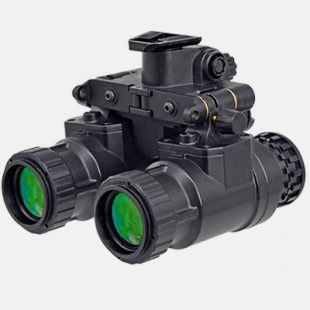
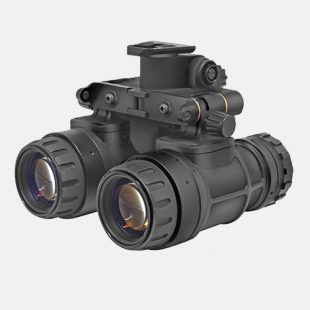
The tested unit was an LDNVG31 binocular night vision system equipped with green-phosphor FOM1400 tubes.
The listed specification for this configuration is approximately:
·FOM: 1400
·Signal-to-noise ratio: 23
·Resolution: 60 lp/mm
·Phosphor type: P43 green
·Magnification: 1×
This places the device in an accessible entry-level category for real image-intensifier binocular night vision.
It is not intended to match the lowest-noise performance of FOM1800 or FOM2000 tubes. Instead, it provides a more affordable way to enter a true dual-tube system without relying on a digital sensor and display.
That distinction remains important. The LDNVG31 is still an optical image-intensifier system, even in its FOM1400 configuration.
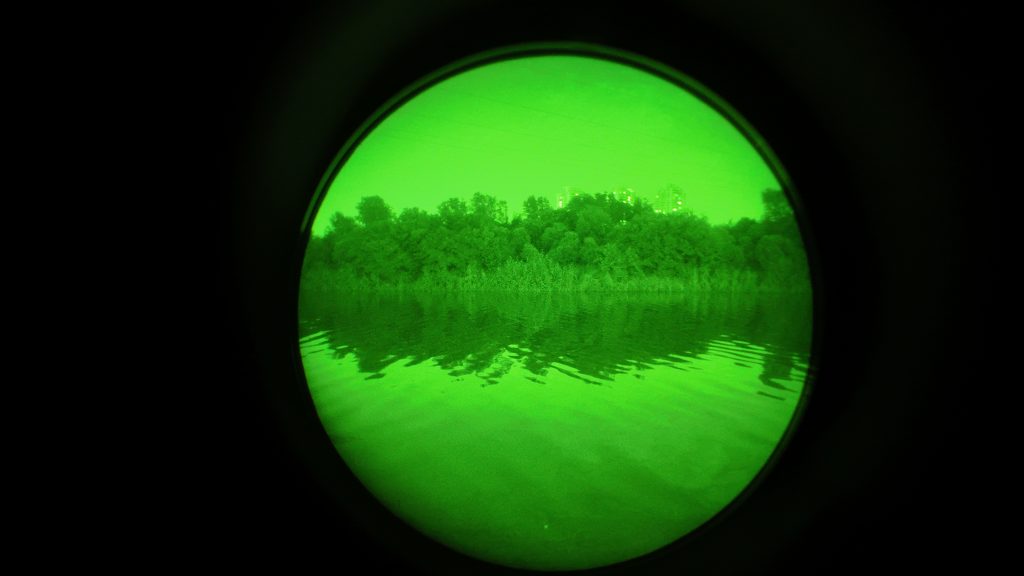
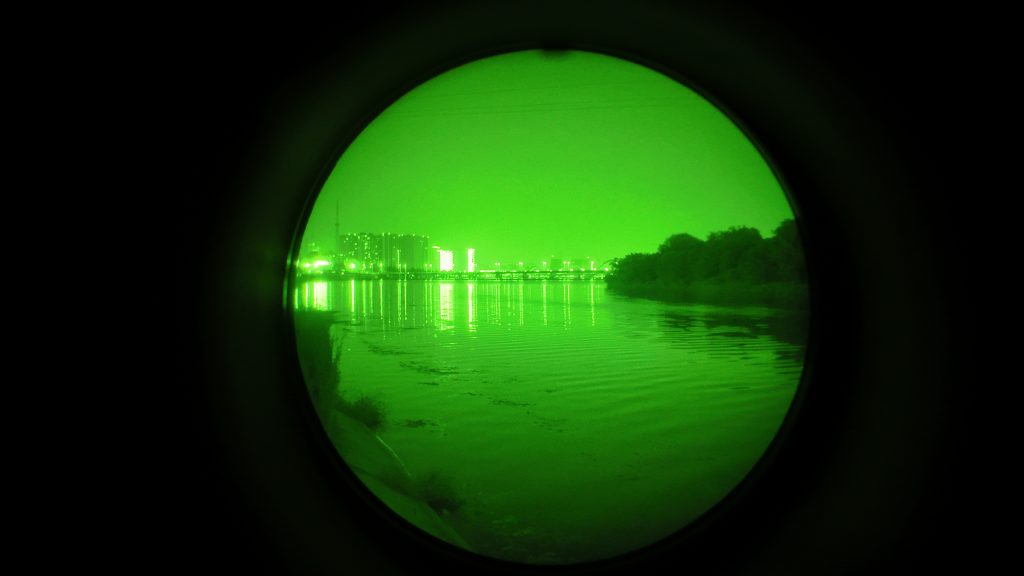
The first image shows a shoreline dominated by trees and vegetation, with several distant buildings visible above the tree line.
This scene is useful because most of the image does not contain strong direct artificial lighting. The device has to separate the darker tree line from the sky and preserve enough contrast to show the water and its reflections.
Several practical points are visible:
·The outline of the tree line remains easy to follow.
·Larger vegetation shapes are clearly separated from the water.
·The distant buildings remain visible behind the trees.
·Reflections on the water can still be distinguished.
·Fine detail is more limited than the main outlines and larger objects.
This is a reasonable example of what FOM1400 is designed to provide: usable environmental awareness rather than maximum fine-detail recognition.
For general observation, orientation and shoreline inspection, the image contains enough information to understand the scene quickly.
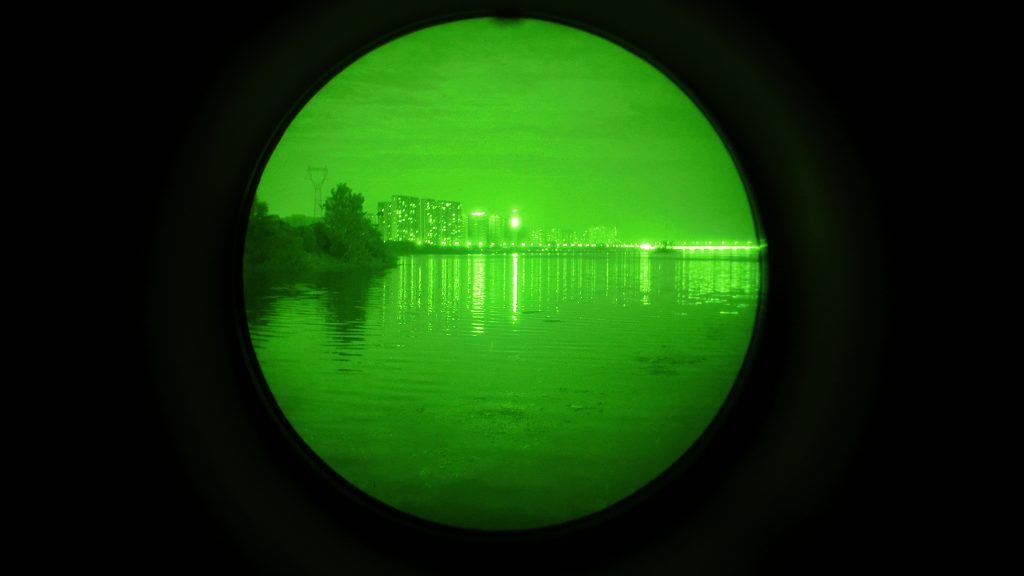
The second image contains much stronger artificial lighting.
Buildings, streetlights and waterfront lighting create multiple bright points, while the trees on the right side remain comparatively dark. This creates a mixed-brightness scene that is more demanding than a uniformly dark landscape.
The image shows that:
·The illuminated buildings are easy to locate and identify.
·Reflections from the city lights remain visible across the water.
·The dark tree line on the right is still separated from the brighter background.
·The strongest lights create visible brightness expansion around the source.
·Fine detail close to intense light sources is less distinct.
This is normal behavior in image-intensifier night vision. Bright artificial lights can create halo or blooming effects, particularly when they are surrounded by much darker areas.
The important question is not whether the lights appear perfectly controlled. It is whether the rest of the scene remains usable.
In this frame, the user can still understand the shoreline, the water, the building positions and the darker vegetation despite the strong light sources.
Green phosphor remains practical because the human eye is highly responsive to green light.
In these test images, the green presentation makes the outlines of trees, buildings and reflections easy to follow. It also gives the image a familiar night vision appearance that many users still prefer.
Green phosphor should not automatically be treated as inferior to white phosphor.
Phosphor color describes the visual presentation. Tube quality is determined by a wider group of factors, including:
·SNR
·Resolution
·FOM
·EBI
·Halo
·Tube cosmetics
·Optical quality
A strong green-phosphor tube can outperform a weaker white-phosphor tube. The choice should be based on the complete specification and the intended use, not color alone.
Based on these test scenes, the green FOM1400 configuration is suitable for users who need:
·General nighttime outdoor observation
·Farm or property inspection
·Waterfront or open-area observation
·Recognition of large environmental features
·Helmet-mounted navigation in usable ambient light
·A more affordable entry into binocular image-intensifier night vision
The device performs particularly well when the scene contains some moonlight, distant city light or other ambient illumination.
The binocular format also provides a more natural two-eye experience than a single monocular. Even when the tubes are not the highest grade, using both eyes can improve comfort and overall environmental awareness.
The test also shows why higher-FOM configurations exist.
In the darkest vegetation, fine detail is reduced. Strong artificial lights can create visible halo, while very dark areas may show more grain and less contrast.
Compared with a stronger-SNR tube, a FOM1400 system will generally:
·Show more visible noise in very low ambient light
·Lose fine shadow detail sooner
·Require more environmental light for its best image
·Benefit more from IR assistance in extremely dark areas
·Provide less separation between small low-contrast objects
These limitations do not make the system unsuitable.
They define its operating level.
A buyer who mainly needs general observation and environmental awareness may not require a higher tube grade. A buyer who regularly operates under heavy tree cover or in extremely dark rural conditions may benefit from FOM1800 or FOM2000 tubes.
This configuration is most suitable for buyers who want a real binocular night vision system but do not need the highest available low-light specification.
It is a sensible choice for:
·First-time dual-tube buyers
·Users upgrading from digital night vision
·General outdoor observation
·Property and farm inspection
·Buyers who value binocular comfort
·Customers balancing performance and budget
It may not be the best choice for users who need maximum detail in extremely dark conditions without IR assistance.
For those buyers, a higher-SNR and higher-FOM configuration is more appropriate.
The green-phosphor LDNVG31 FOM1400 performs as an accessible dual-tube system should.
It provides:
·Clear large-scale scene recognition
·Useful water and shoreline separation
·Visible buildings and vegetation
·A natural binocular platform
·Practical performance under mixed ambient lighting
Its limitations also appear honestly:
·Dark vegetation contains less fine detail
·Strong lights produce visible halo
·Low-light noise increases in weaker illumination
·Higher-grade tubes would provide a calmer and more detailed image
The important point is that FOM1400 should not be judged as either simply “good” or “bad.”
It should be judged according to the intended environment, required detail level and available budget.
For many general-use customers, this configuration provides a practical entry into real binocular night vision.
Specifications explain part of the product. Real footage explains the rest.
These three images show how the LDNVG31 FOM1400 handles vegetation, water, distant buildings and strong city lighting in a real outdoor environment.
The device is not designed to hide the difference between FOM1400 and a premium tube. It is designed to offer a useful and accessible binocular night vision experience.
For customers who need stronger shadow detail and lower noise in extremely dark environments, higher-FOM options remain available.
For customers who need practical nighttime awareness and a true two-eye image-intensifier system, the FOM1400 LDNVG31 can be a reasonable starting point.
FOM1400 can be sufficient for general outdoor observation, property inspection and entry-level helmet-mounted use. Buyers who regularly operate in extremely dark environments may benefit from higher-SNR tubes.
A camera normally records through one eyepiece. The images therefore do not reproduce the full binocular experience of using both tubes with both eyes.
Strong light sources can produce halo or blooming around the source. The amount depends on the tube, the brightness of the light and the surrounding environment.
No. Phosphor color changes how the image is presented but does not alone determine image quality. FOM, SNR, resolution, EBI, halo, optics and tube cleanliness also matter.
That depends on the amount of ambient light and whether IR was active during the recorded test. Passive and IR-assisted footage should be labeled separately in the final video.
Yes. It provides a true image-intensifier binocular experience with very low latency and passive viewing capability under suitable ambient light.