Recent Post
A customer is comparing two night vision tubes.
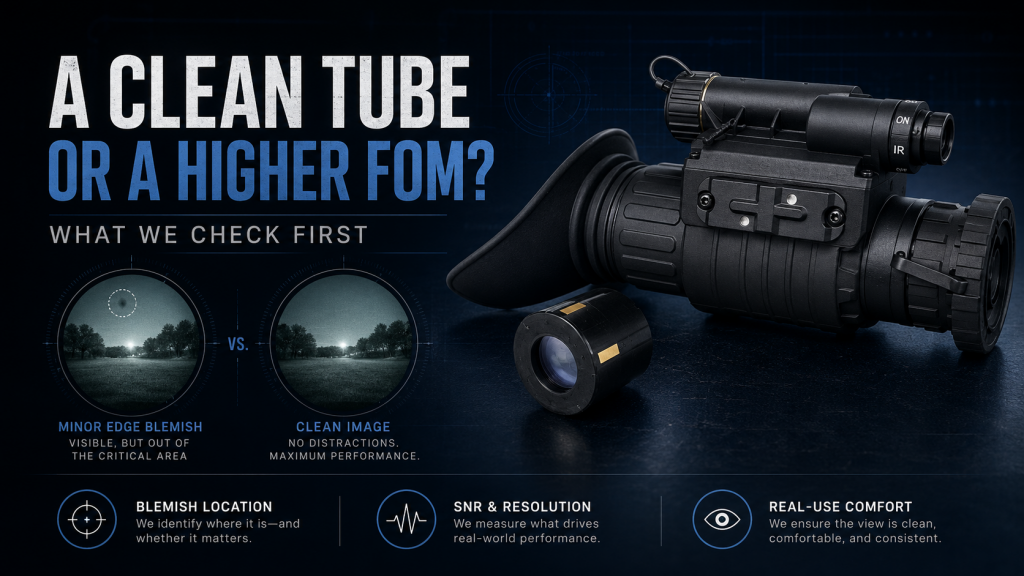
The first tube has a higher FOM, but there is a visible dark spot near the center of the image. The second tube has a slightly lower FOM, but the image looks clean and even.
Which one should they choose?
There is no automatic answer.
For some users, the higher-performance tube is the better purchase. For others, the cleaner tube will be far more comfortable to use. The right choice depends on where the blemish is located, how large it is, how much the specifications differ, and what the device will actually be used for.
When we compare tubes, we do not start with FOM alone. We look at the complete image.
FOM, or Figure of Merit, is calculated from resolution and signal-to-noise ratio:
FOM = Resolution × SNR
It is a useful comparison number. In general, a tube with stronger SNR and resolution should provide better image detail and low-light performance.
But FOM cannot show you everything.
It does not tell you whether the tube has a dark spot near the center. It does not describe image shading, edge distortion, halo, background glow, or how even the image appears from one side to the other.
Two tubes with a similar FOM can still look noticeably different.
This is why we use FOM as a starting point, not as the final decision.
When customers ask for a clean tube, they are usually talking about tube cosmetics.
A clean tube has few visible dark spots, marks, or distracting imperfections in the image. It does not necessarily mean the tube has the highest specifications. It means the viewing area appears clear and visually comfortable.
Small blemishes are not unusual in image intensifier tubes. They can appear during the manufacturing process, and their effect depends heavily on size and location.
A tiny mark near the outer edge may be difficult to notice during normal outdoor use. A similar mark near the center may attract the eye every time the user looks through the device.
That is why the location of a blemish often matters more than the total number of spots.
The viewing area is commonly considered in zones.
The center area is where the user naturally looks when identifying objects, checking terrain, or moving through an environment. A blemish in this area is more likely to be distracting.
Marks farther toward the edge are usually easier to ignore because the user is not constantly focusing on them.
When we assess a tube image, we therefore ask:
·Is the blemish close to the center?
·Is it visible during normal outdoor viewing?
·Does the eye keep returning to it?
·Is it only obvious against a bright wall or test surface?
·Will the device be used for observation, movement, photography, or recording?
A tube photograph taken against a plain wall often makes every imperfection look more serious. Outdoors, with trees, terrain, shadows, and changing contrast, small edge blemishes may almost disappear.
A central blemish is different. Once noticed, it can be difficult to stop noticing it.
We would normally give more weight to the higher-FOM tube when the performance difference is meaningful and the cosmetic issue is minor.
For example, the higher-specification tube may be the better choice when:
·Its SNR is clearly stronger.
·It performs better in very low ambient light.
·The blemish is small and near the outer edge.
·The user prioritizes detection and low-light performance.
·The device will be used mainly outdoors rather than for filming through the tube.
·The price difference is reasonable.
A small edge spot does not automatically make a high-performance tube a poor choice.
In difficult lighting, stronger SNR may be far more noticeable than a minor cosmetic mark. The user may gain a cleaner low-light image, better contrast, and less visible noise.
For performance-focused buyers, that can be the more important advantage.
We would normally favor the cleaner tube when the specification difference is small or the higher-FOM tube has a distracting central blemish.
The cleaner tube may be the better choice when:
·The FOM difference is modest.
·Both tubes already meet the user’s performance needs.
·The blemish is located near the center.
·The user is sensitive to visible spots.
·The device will be used for photography or video through the eyepiece.
·The buyer values a clean-looking image more than the highest possible number.
A tube with slightly lower FOM can still provide an excellent real-world image.
If one tube is FOM 1800 and another is slightly higher, the difference may be less important to the user than a dark mark that remains visible every time the device is switched on.
The specification sheet matters, but so does the experience of looking through the tube.
A normal cosmetic blemish does not necessarily mean that the tube has poor gain, poor SNR, or poor resolution.
The tube may still perform very well in low light.
However, not every visible defect should be treated as a harmless cosmetic spot. Bright points, flashing points, strong shading, unusual patterns, or serious image distortion may require a different assessment.
It is also worth checking whether a visible mark is actually inside the tube. Dust on a lens, eyepiece, or optical surface can sometimes be mistaken for a tube blemish.
Before rejecting a device, the image and optics should be inspected carefully.
The decision becomes more complicated with binocular night vision.
For a PVS-31 style system, we do not only compare the FOM of each tube. We also look at whether the two images feel balanced.
Important factors include:
·Similar brightness
·Similar phosphor appearance
·Comparable SNR and resolution
·Similar gain characteristics
·Similar image cleanliness
·No distracting mismatch between the left and right eye
A very clean tube paired with a noticeably different tube may still produce an uncomfortable binocular experience.
For dual-tube systems, a well-matched pair is often more important than selecting the two highest individual FOM numbers available.
Our basic inspection order is straightforward.
First, we check the intended use. A helmet-mounted outdoor user may prioritize low-light performance. A collector or photography-focused buyer may care more about image cosmetics.
Second, we check SNR, resolution, and FOM. We want to understand whether the performance difference is actually meaningful.
Third, we inspect the tube image. We look at blemish size, position, image uniformity, shading, and edge quality.
Fourth, we consider the complete device. Good tube specifications cannot compensate for poor lenses, a weak housing, incorrect assembly, or a badly matched binocular system.
Finally, we compare price. A higher number only makes sense when the user can benefit from it.
If the blemish is small, near the edge, and the higher-FOM tube offers a clear performance advantage, we usually choose the higher-FOM tube.
If the blemish is central and distracting, while the specification difference is small, we usually choose the cleaner tube.
If both tubes already provide sufficient performance, image comfort becomes more important.
The best tube is not always the tube with the highest FOM.
It is the tube whose performance, cosmetics, and price make sense for the person using it.
Tube specifications are important because they give us measurable information. Tube photographs are important because they show what the specification sheet cannot.
A serious comparison needs both.
Do not reject a strong tube because of one tiny edge spot. At the same time, do not accept a distracting central blemish simply because the FOM number is higher.
A clean tube and a high-performance tube are not opposites. The ideal choice provides both. When that is not possible, the correct compromise depends on the job.
That is what we check first.
Not necessarily. Small cosmetic blemishes are common and may have little effect during normal outdoor use. Their size and location are more important than their presence alone.
No. FOM describes performance based on resolution and SNR. It does not describe cosmetic blemishes or image uniformity.
Usually, yes. Central marks are more likely to remain in the user’s main field of attention, while small edge marks are often easier to ignore.
It can be the better choice when the FOM difference is small and the cleaner image matters more to you. The intended use should guide the decision.
A normal cosmetic blemish does not automatically mean the tube has low SNR. Tube cosmetics and measured performance should be evaluated separately.
In addition to individual tube quality, the two tubes should be well matched in brightness, phosphor appearance, gain, specifications, and image cosmetics.