Recent Post
If you've been looking at night vision devices recently, you've probably noticed the same debate everywhere:
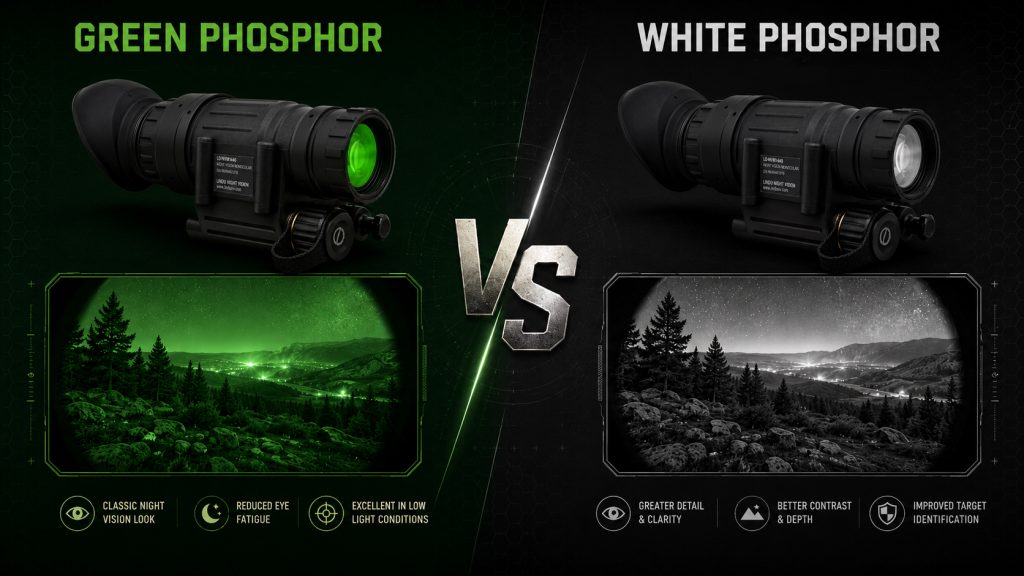
Some users swear by traditional green tubes. Others won't use anything except white phosphor anymore. The truth is, both have their strengths, and the better option really depends on how the device will be used.
This article breaks down the actual differences between the two, without the marketing hype.
Inside every image intensifier tube, there's a phosphor screen that converts electrons into the image you see through the eyepiece.
That screen is what creates the final image color.
Most night vision devices today use one of these two phosphor types:
Green phosphor has been the standard for decades and is still extremely common in devices like PVS-7 and PVS-14 systems.
White phosphor came later and has become increasingly popular in higher-end binocular systems because of its more natural-looking image.
At the end of the day, both are designed for the same purpose: helping users see clearly in low-light environments.
The difference is mainly in how the image looks and how your eyes respond to it over time.
For many people, green is what night vision is supposed to look like.
There's a reason it stayed dominant for so many years.
Green phosphor tubes are usually more affordable, which makes them attractive for training, recreational use, or larger quantity purchases.
A lot of experienced users simply prefer the classic green image because that's what they trained with for years.
The biggest complaint is eye fatigue.
After extended use, especially during longer nighttime sessions, the bright green image can become tiring for some users.
Another issue is perceived contrast. In areas with shadows or uneven lighting, smaller details may not stand out as clearly compared to white phosphor systems.
White phosphor produces a grayscale image instead of a green one.
For many users, it feels more natural and easier to process visually.
That's one of the main reasons white phosphor systems became so popular in the professional market over the past few years.
Edges, textures, and shadow details often appear sharper and easier to distinguish.
Many users find grayscale viewing more comfortable during long observation periods.
Instead of the bright green glow, white phosphor gives a softer black-and-white image that resembles natural nighttime vision more closely.
The main drawback is price.
White phosphor tubes are usually more expensive, especially when paired with high-spec image intensifier tubes.
For some users, the performance improvement is absolutely worth it.
For others, green phosphor already does everything they need.
There isn't a universal answer.
If budget matters most and you want reliable night vision performance, green phosphor is still a solid option.
If you spend long hours behind night vision devices and want a more comfortable viewing experience with improved detail perception, white phosphor is hard to beat.
In real-world use, both technologies are effective. The “best” choice usually comes down to personal preference, application, and budget.
Green phosphor remains one of the most practical and widely used night vision solutions available today.
White phosphor, on the other hand, offers a more modern viewing experience that many users now prefer for extended nighttime use.
Neither one is automatically better in every situation.
The important thing is choosing a system that fits your actual needs instead of just following trends.
We offer a range of night vision solutions including:
● PVS-14 monocular systems
● PVS-31 binocular night vision devices
● White phosphor night vision goggles
● Wide field-of-view panoramic systems
OEM and ODM support is also available for distributors and professional buyers worldwide.