Home » knowledge » Professional analysis of the “emission point” phenomenon of night vision device
Professional analysis of the “emission point” phenomenon of night vision device
2026.01.22
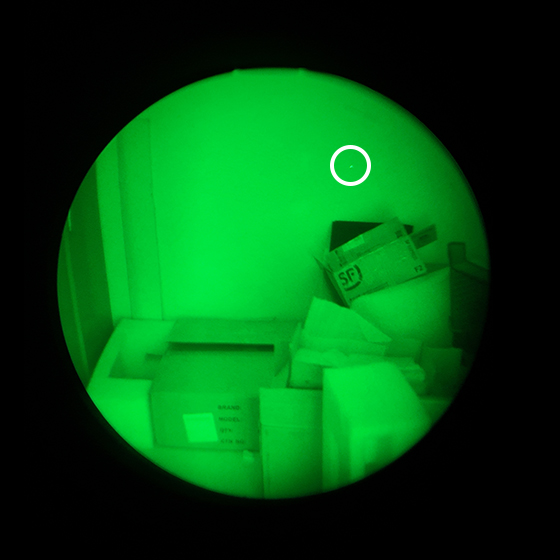
When you use an/pvs-31 night vision goggles to observe, if a steady or fluctuating pinpoint of bright light appears in the image area that does not go away when all light is blocked from the objective lens, this light spot is the "Emission Point".This is an inherent phenomenon of the imaging device inside the pvs 7 night vision goggles, and its characteristics need to be accurately identified:
Absolutely fixed position: The position of an emission point within the field of view will not move, which is the core criterion that distinguishes it from the real scene light source (whose position changes as the equipment moves).
Brightness environment correlation: If an emission point disappears or is only faintly visible when viewing under brighter nighttime conditions, it is normal and is not indicative of a problem. Its brightness is affected by the ambient light level
Fault judgment signs: If the emission point remains bright under all lighting conditions (especially in all dark), it strongly indicates that there is physical damage or defects in the internal imaging device of the pvs 14 night vision device (such as the microchannel plate MCP or fluorescent screen), and the equipment requires professional repair.
Cause nature:
The emission point originates from an abnormality in a small local area in the core imaging chain of the night vision device (photocathode -> microchannel plate MCP ->fluorescent screen). The most common causes are:
Microchannel plate (MCP) defects: There are abnormalities (such as tiny impurities or structural damage) at the entrance of individual microchannels on the MCP, resulting in abnormally high electron gain at that point.
Fluorescent screen damage: There are tiny flaws or damaged spots in the fluorescent screen coating that produce abnormally bright and continuous light emissions when bombarded by electrons.
Response and Importance:
Primary task: To strictly distinguish the emission point from the point light source in the real scene (such as distant stars and lights). Position fixity is the key identification point.
Normal situation (as ambient light decreases): No intervention is required, and you can continue to use it.
Abnormal situation (continuously high bright in all dark): It indicates that there is a hard damage point inside and needs to be repaired in time. Continuous use may cause the damage to expand or affect the observation effect.
Understanding the characteristics and criteria of the emission point is the key to ensuring the effective operation and timely maintenance of night vision devices. Only by accurately identifying the nature of its non-scene light source and the law of brightness change can we distinguish between normal phenomena and fault signals.