Recent Post
When diving into the world of high-end night vision, you will quickly encounter a technical debate that divides professionals and enthusiasts alike: Auto Gain vs. Manual Gain. Whether you are looking to purchase your first an pvs-14 or upgrading to a professional-grade pvs31a, understanding how these systems manage light amplification is crucial for your performance in the field.
In this guide, we will break down the differences, pros, and cons of each system to help you make an informed investment.
In the context of Image Intensifier Tubes (IIT), "Gain" refers to the degree to which the device amplifies the available ambient light. Think of it like the ISO setting on a camera or the volume knob on a radio. The higher the gain, the brighter the image—but there is always a trade-off with "noise" or scintillation (the grainy look in the display).
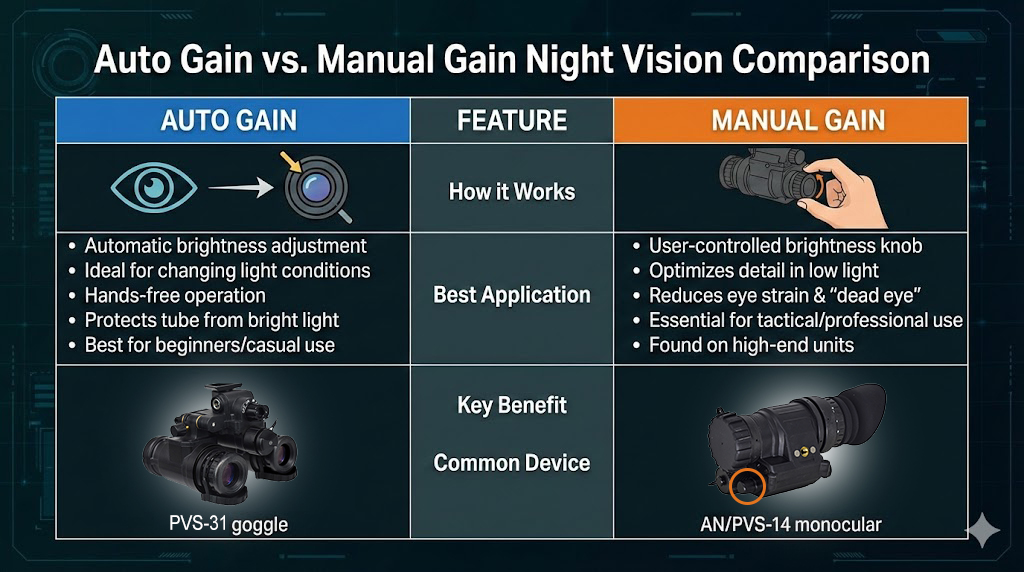
Auto Gain systems (often associated with Automatic Brightness Control or ABC) automatically adjust the brightness of the image based on the environment.
When you move from a pitch-black forest into a moonlit clearing, an Auto Gain system senses the increase in light and automatically dials back the amplification. This protects the tube from damage and prevents the user from being "blinded" by a sudden flash of light.
Manual Gain allows the operator to physically turn a knob (usually located on the battery housing) to increase or decrease the light amplification. This feature is a hallmark of the pvs 14 gen 3 and other high-performance units.
In extremely low-light environments, pushing the gain to its maximum can cause too much "noise," making it hard to see fine details. A skilled user will manually turn the gain down just enough to crisp up the image and reduce eye fatigue.
The choice between auto and manual often depends on the specific device architecture:
There is no "wrong" choice, but there is a "better" choice for your specific mission profile. While auto gain offers simplicity and protection, manual gain offers the precision required for high-stakes navigation and target identification.
If your budget allows, opting for a manual gain unit like the pvs-14 gen 3 provides the most flexibility. However, if you are looking at the pinnacle of technology and can justify the gpnvg-18 price, you’ll find that the industry is moving toward "smart" systems that combine the best of both worlds.
Ready to see the dark in a new light? Check out our range of PVS-14 and PVS-31A units today!