Recent Post
Not sure whether to choose Gen 2+ or Gen 3 night vision? This guide explains the real difference in image quality, low-light performance, price, lifespan, and buying advice before ordering.
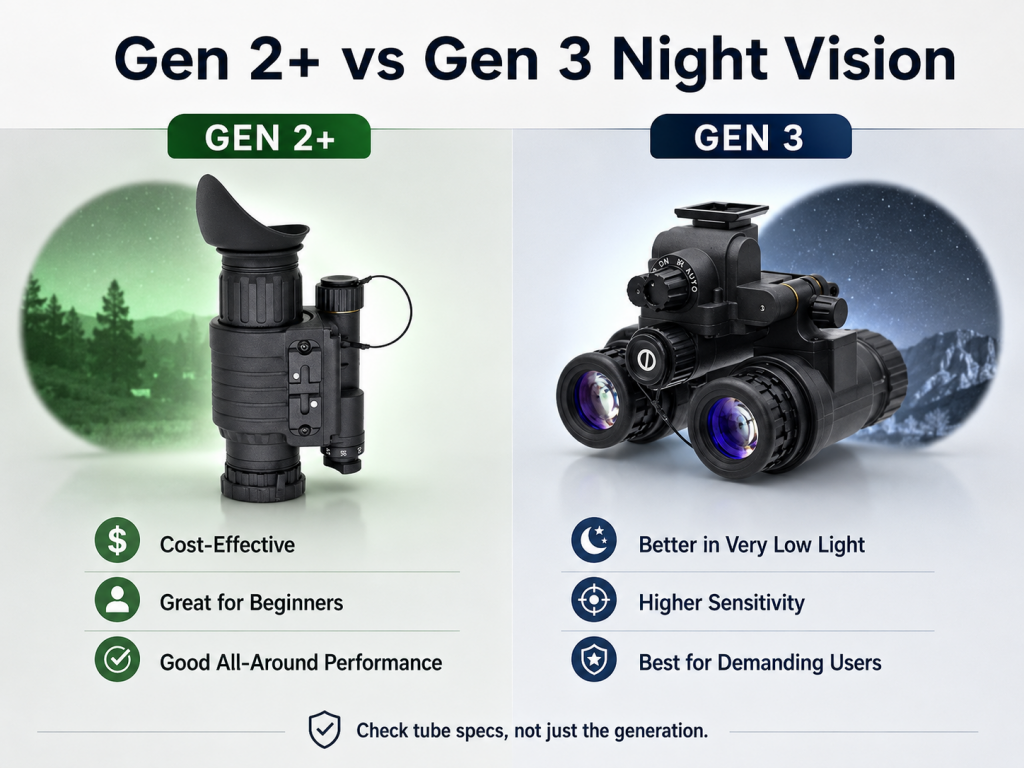
Choosing a night vision device can be confusing, especially when you see both Gen 2+ night vision and Gen 3 night vision on the market.
Many buyers naturally think that Gen 3 is always better because it is more expensive and often used in higher-end systems. In many cases, Gen 3 does offer stronger low-light performance, better sensitivity, and longer tube life.
However, that does not mean Gen 2+ is a bad choice.
For many outdoor users, security teams, wildlife observers, patrol users, and budget-conscious buyers, a good Gen 2+ night vision device can already provide clear and practical night observation.
The better choice depends on your real use, your budget, the tube specifications, and how dark your working environment usually is.
Before placing an order, it is important to understand the real difference between Gen 2+ and Gen 3 night vision.
What Is Gen 2+ Night Vision?
Gen 2+ night vision is an improved version of second-generation image intensifier technology.
Compared with basic Gen 2 devices, Gen 2+ tubes usually offer better resolution, better signal-to-noise ratio, improved image clarity, and more stable performance in low-light environments.
A Gen 2+ night vision device can be used for many common applications, such as:
- Outdoor observation
- Farm and property security
- Wildlife watching
- Night hiking
- Search and patrol
Entry-level professional use
· Training and general night observation
For users who need reliable night vision but do not want to pay the highest price, Gen 2+ is often a very cost-effective choice.
It can provide a bright and usable image under moonlight, starlight, or with the help of an infrared illuminator in darker environments.
Gen 3 night vision is a more advanced image intensifier technology. The key improvement is the use of a more sensitive photocathode material, which allows the tube to collect and amplify very low levels of light more effectively.
In real use, this means Gen 3 night vision usually performs better in extremely dark environments.
When there is very little ambient light, such as deep forest, remote fields, cloudy nights, or open outdoor areas with no artificial light, Gen 3 can often deliver a brighter and cleaner image than most Gen 2+ devices.
Gen 3 night vision is commonly used in:
- Professional outdoor patrol
- Long-duration observation
- Law enforcement applications
- High-end night vision monoculars
- Binocular night vision goggles
- Users who require stronger low-light performance
If your work depends heavily on night vision performance and you often use the device in very dark areas, Gen 3 is usually the better option.
The biggest difference is not just the name of the generation.
The real difference is in light sensitivity, image brightness, noise control, tube life, and price.
A Gen 2+ device can perform very well in many normal night environments. But when the light becomes extremely limited, Gen 3 usually shows its advantage.
In simple terms:
Gen 2+ is practical and cost-effective.
Gen 3 is stronger in very low light and more suitable for demanding users.
That is why both options still have their own market.
Low-light performance is one of the most important differences.
Gen 3 night vision usually provides better image brightness and detail when there is very little natural light. This is especially useful when you are working under cloudy starlight, in forest areas, or in open fields without street lights.
Gen 2+ night vision also works well, but it may need more ambient light or an infrared illuminator in darker conditions.
For casual outdoor use, farm security, short-distance observation, and general night patrol, Gen 2+ can be enough.
But for users who often work in extremely dark environments, Gen 3 provides more confidence.
Image clarity depends on many factors, including tube quality, lens quality, resolution, SNR, FOM, phosphor type, and device design.
A high-quality Gen 2+ tube may look better than a low-grade Gen 3 tube in some situations. This is why buyers should not only look at “Gen 2+” or “Gen 3” as a label
You should also check:
- Resolution
- SNR
- FOM
- EBI
- Halo
- Gain
- Phosphor type
- Lens quality
- Housing quality
Gen 3 generally has better performance potential, but the final image quality still depends on the actual tube specifications.
So before ordering, do not only ask, “Is it Gen 3?”
A better question is:
“What are the tube specs?”
Gen 3 tubes are often known for longer service life and stronger reliability. This is one reason why many professional users prefer Gen 3 night vision devices.
However, modern Gen 2+ tubes can also be reliable when used properly.
No matter which generation you choose, correct use and maintenance are very important.
To protect your night vision device:
- Avoid exposing the tube to strong light for long periods
- Use lens caps when not in use
- Store the device in a dry and clean place
- Remove batteries during long-term storage
- Clean lenses carefully
- Use the device according to the manufacturer’s instructions
A good tube can last much longer when it is used and stored correctly.
Final Buying Advice
If you are a beginner or need a practical night vision device for general outdoor use, Gen 2+ night vision is often the smarter choice. It is more affordable, easier to start with, and already powerful enough for many night observation tasks.
If you are a professional user, often work in very dark conditions, or want the best possible low-light performance, Gen 3 night vision is worth the investment.
The best night vision device is not always the most expensive one.
It is the one that matches your real environment, your budget, and your application.
Before ordering, check the tube specifications, housing quality, optical system, and supplier support. If you are not sure which model is right for you, contact LinduNV for professional advice and product recommendations.