Recent Post
If you've spent any time around modern night vision users, you've probably noticed something interesting: more and more helmets are showing up with a thermal fusion device mounted in front of a PVS-14 or dual-tube system.
A few years ago, thermal fusion was something most people only saw in specialized military units. Today, it's becoming increasingly common among professional users, security teams, search-and-rescue operators, and experienced night vision enthusiasts.
The answer is simple: traditional night vision helps you see, but thermal fusion helps you notice what you would otherwise miss.
Even the best image intensifier tubes have limitations.
A person standing motionless in the shadows can blend into the background. An animal partially hidden by brush may be difficult to spot. A vehicle parked under tree cover can disappear into the surrounding terrain.
Night vision provides excellent detail, but it still relies on reflected light.
This is where thermal technology changes the game.Most modern thermal fusion systems combine thermal sensors with image intensifier technology to improve detection performance.
Instead of looking for visible contrast, thermal sensors detect differences in heat. Anything warmer than its surroundings becomes easier to locate, even when visual identification is difficult.
Many first-time buyers assume a thermal monocular is enough.
In reality, most experienced users prefer thermal fusion because it combines the strengths of both systems.
A standalone thermal device is excellent for detection, but navigating through terrain with thermal alone can feel unnatural. Rocks, branches, trails, and other environmental details often lack the clarity provided by a night vision device.
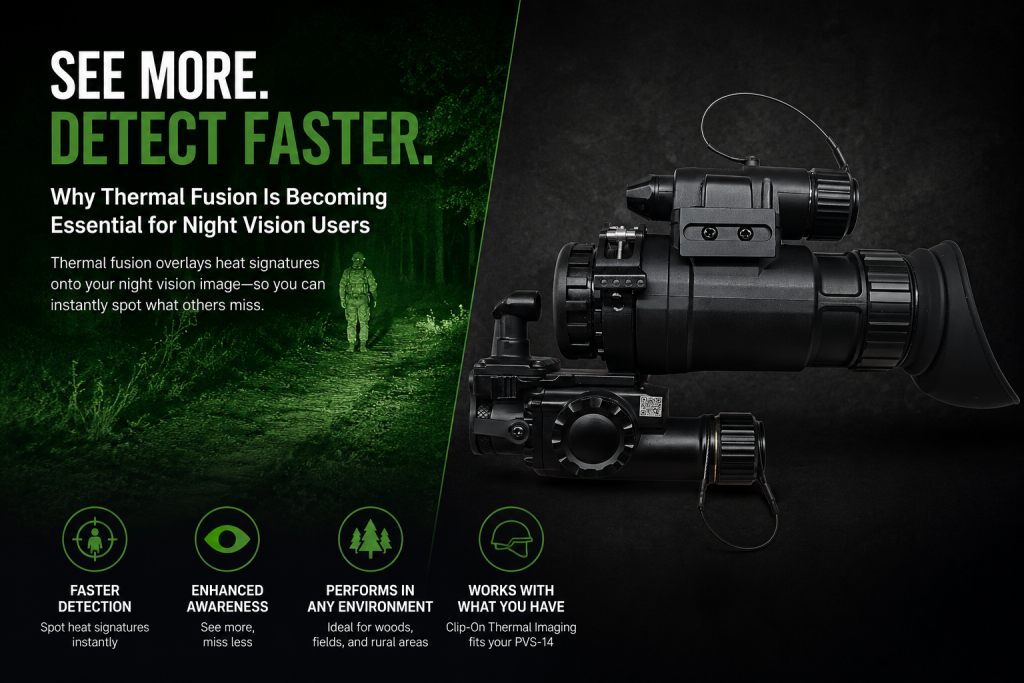
With a COTI mounted in front of a PVS-14, you keep the familiar image intensifier view while thermal signatures appear directly within the scene.
Instead of switching between two devices, you see everything at once.
That's a major reason why thermal fusion systems have become increasingly popular.
One of the most common comments from first-time COTI users is how quickly their eyes start finding targets.
A person partially hidden behind vegetation may immediately stand out because of body heat.
A recently operated vehicle can reveal itself long before details become visible through night vision alone.
Animals that would normally blend into the environment become much easier to locate.
The goal isn't necessarily identification.
The goal is detection.
Once something catches your attention through the thermal overlay, you can use your night vision image to determine exactly what you're looking at.
Thermal fusion tends to shine in environments where visual clutter is common.
Wooded areas, open fields, brush lines, and uneven terrain all create opportunities for people, animals, and objects to blend into the background.
Traditional night vision still performs well in these conditions, but thermal overlay often reveals details that users might otherwise overlook.
This is one reason why thermal fusion has become increasingly common among wildlife observers, landowners, and nighttime security personnel.
Another reason for the growing popularity of COTI systems is that users don't have to replace their entire setup.
Many professionals already own a PVS-14 or dual-tube night vision system. Adding thermal fusion provides a significant capability upgrade without changing the way they operate.
For users who have already invested in quality night vision equipment, this modular approach often makes more sense than starting over with a completely different system.
That depends on how you use your night vision equipment.
If your primary goal is simply navigating in the dark, a high-quality image intensifier tube may be all you need.
But if target detection is important—whether for security work, wildlife observation, search and rescue, or professional nighttime operations—thermal fusion can provide a noticeable advantage.
The ability to instantly spot heat signatures while maintaining a natural night vision image is exactly why more professionals are choosing COTI systems today.
A COTI (Clip-On Thermal Imager) is a thermal overlay device designed to work with traditional night vision systems. Instead of replacing your night vision device, it adds thermal information directly into your field of view, helping users detect heat signatures more effectively.
Traditional night vision amplifies available light to create a visible image, while thermal fusion detects heat emitted by people, animals, and objects. By combining both technologies, thermal fusion provides enhanced situational awareness and faster target detection.
Yes. Many thermal fusion systems are designed to integrate with PVS-14 night vision monoculars. This combination allows users to maintain the natural image provided by night vision while benefiting from thermal detection capabilities.
Not necessarily. Thermal fusion and thermal monoculars serve different purposes. A thermal monocular is primarily used for detection, while thermal fusion allows users to navigate and observe their environment through night vision while simultaneously seeing thermal overlays.
Faster target detection
Improved situational awareness
Enhanced visibility in cluttered environments
Better performance in wooded or rural areas
Reduced chance of overlooking concealed subjects
Yes. Wildlife observers often use thermal fusion systems to locate animals that may be difficult to spot with traditional night vision alone. Thermal signatures can help identify animals hidden by vegetation or darkness.
Thermal fusion may help users detect heat signatures through light vegetation where traditional night vision may struggle. However, detection performance depends on environmental conditions, vegetation density, and the specific thermal sensor being used.
Many professionals value thermal fusion because it combines the strengths of both night vision and thermal imaging. Users gain improved detection capabilities without sacrificing the detailed environmental view provided by image intensifier devices.
For users who prioritize target detection, surveillance, search and rescue, or advanced nighttime observation, thermal fusion can provide a significant advantage. The value depends on individual requirements and operational needs.
PVS-14 monoculars
Dual-tube night vision goggles
Gen2+ night vision devices
Gen3 white phosphor systems
Professional image intensifier-based night vision platforms