Recent Post
When buying a night vision device, most people quickly run into three numbers: FOM, SNR, and resolution.
At first, these specs can look confusing. One product may list FOM 1400. Another may list FOM 1800 or 2000. Some sellers talk about 64 lp/mm resolution, while others focus on signal-to-noise ratio. So which number actually matters most?
The short answer is this:
SNR usually matters the most for real image clarity. FOM is useful for comparing overall tube performance. Resolution matters too, but only when it is supported by good SNR, clean optics, and a well-built night vision system.
In other words, do not judge a night vision device by one number alone. A better buying decision comes from understanding how these specs work together.
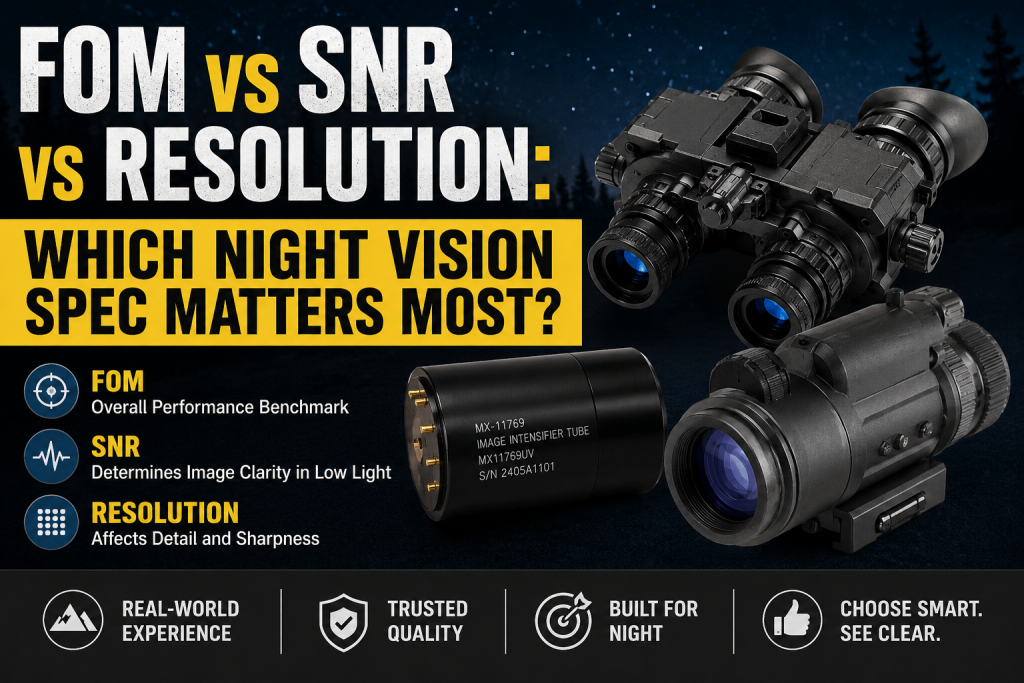
FOM stands for Figure of Merit. It is a performance number commonly used to compare image intensifier tubes.
The basic formula is:
FOM = Resolution × SNR
For example, if a tube has 64 lp/mm resolution and an SNR of 25, the FOM would be:
64 × 25 = 1600 FOM
This makes FOM a useful shortcut. It gives buyers a quick way to compare tube performance without checking every single detail.
But FOM is not the whole story.
A tube with higher FOM is often better, but that does not automatically mean it will look better in every real-world situation. The way that FOM is achieved matters. A tube with strong SNR and solid resolution will usually feel better than a tube that only looks good on paper.
SNR stands for Signal-to-Noise Ratio.
In simple terms, SNR tells you how much useful image signal the tube produces compared with visual noise.
A higher SNR usually means a cleaner, smoother image. A lower SNR usually means more grain, more sparkle, and a noisier image, especially in darker environments.
This is why many experienced users care so much about SNR. When there is very little light available, the device has to work harder. In those conditions, a higher SNR can make the image easier to read and more comfortable to use.
If you are walking under trees, scanning an open field, checking property at night, or using a helmet-mounted setup for a long period, SNR becomes very noticeable.
A high-resolution tube with weak SNR can still look noisy. A tube with strong SNR can often feel more usable, even if the resolution number is not the highest.
Night vision resolution is usually measured in line pairs per millimeter, written as lp/mm.
Common values include 57 lp/mm, 64 lp/mm, 72 lp/mm, and higher.
Resolution tells you how much detail the tube can separate. Higher resolution can help with sharper edges, finer details, and clearer object shapes.
But there is a catch.
Resolution only matters if the image is clean enough for your eye to use that detail. If the image is full of noise, haze, poor contrast, or optical distortion, a higher resolution number may not give you the real advantage you expected.
That is why resolution should never be judged alone.
If you only remember one thing, remember this:
FOM helps you compare. SNR helps you see. Resolution helps you identify details.
Usually, higher FOM is better, but not always in the way beginners expect.
A higher FOM tube generally indicates stronger overall performance. For example, a FOM 2000 tube will usually outperform a FOM 1400 tube in low-light conditions, assuming the rest of the device is built well.
However, FOM does not tell you everything about the image.
It does not fully describe:
·Tube blemishes
·Edge distortion
·Halo
·EBI
·Phosphor color
·Lens quality
·Housing quality
·Gain control
·Real-world viewing comfort
Two tubes with the same FOM can still look different. One may have better contrast. One may have a cleaner image. One may have fewer visible blemishes. One may simply feel better to use.
That is why FOM should be treated as a useful guide, not a complete judgment.
The right FOM level depends on how you plan to use the device.
For casual outdoor use, property checks, farm use, camping, and basic observation, a lower-to-mid FOM tube can still be very useful.
For more demanding use, such as helmet-mounted movement, long sessions, professional observation, or very dark environments, a higher FOM tube is more valuable.
Here is a simple buying reference:
| FOM Range | General Positioning | Suitable Use |
| Around 1400 FOM | Entry-level practical performance | Basic outdoor use, observation, beginner setup |
| Around 1600 FOM | Balanced performance | General night movement, property security, helmet use |
| Around 1800 FOM | Stronger low-light performance | More serious users, longer sessions, mixed environments |
| Around 2000 FOM and above | Higher-performance tube class | Demanding use, better clarity, improved low-light viewing |
This does not mean 1400 FOM is bad. It means you should match the tube to your use case and budget.
A beginner who mainly uses night vision for outdoor observation may not need the highest FOM available. A user who plans to build a helmet-mounted setup and use it often may benefit from spending more.
Many beginners look at resolution first because sharpness is easy to understand. But in real night vision use, SNR can matter even more.
At night, the challenge is not only seeing fine detail. The challenge is seeing usable detail through darkness, shadows, and low light.
A noisy image can hide detail even when the resolution number is good. It can also make long sessions more tiring because your eye has to work harder to interpret the image.
Higher SNR can make the view feel calmer, cleaner, and more stable. This is especially important when using night vision while walking, scanning, or navigating.
If two tubes have similar FOM, the one with better SNR may often feel better in real use.
Yes, resolution matters. It just should not be the only spec you check.
Higher resolution can help when you need to distinguish finer shapes, read terrain details, or identify objects at distance. It can make the image appear sharper and more refined.
But resolution is only useful when the rest of the system supports it.
For example, poor lens quality can reduce the value of high resolution. Heavy image noise can also make fine detail harder to see. A tube with strong resolution but weak SNR may not feel as clean as expected.
So the better question is not “What is the highest resolution?”
The better question is:
Does this device have a balanced tube, good optics, and the right performance level for my use?
FOM, SNR, and resolution are not the only things that affect your viewing experience. Phosphor color also changes how the image feels.
White phosphor night vision often feels more natural to many users. It can be easier on the eyes during longer sessions and may help users interpret shadows and contrast more comfortably.
Green phosphor is still useful and can be more budget-friendly. Some users still prefer the classic green image, especially for familiar night vision applications.
The important point is this:
A good tube matters more than phosphor color alone.
A strong green phosphor tube can outperform a weak white phosphor tube. A strong white phosphor tube can offer excellent comfort and clarity. The best choice depends on the full specification and your personal use.
For a PVS-14 style night vision monocular, the balance between FOM, SNR, and resolution is especially important.
A PVS-14 is often used as a handheld monocular or helmet-mounted device. That means comfort, clarity, and low-light performance matter more than a single headline number.
If you are buying your first PVS-14, do not only ask for the highest FOM. Ask what kind of use you actually have:
·Do you need it for basic outdoor observation?
·Will you mount it on a helmet?
·Will you use it for long sessions?
·Will you use it in very dark rural areas?
·Do you care more about budget or maximum performance?
For casual observation, a balanced Gen 2+ device may be enough. For more serious use, higher FOM and stronger SNR become more attractive.
For binocular night vision goggles like a PVS-31 style device, specs become even more important because both eyes are involved.
When using dual-tube night vision, the overall experience depends on tube matching, image balance, clarity, and comfort. If one tube looks noticeably different from the other, the viewing experience can feel less natural.
For PVS-31 buyers, FOM is useful, but tube consistency is also important. A clean and balanced pair of tubes can matter more than chasing the highest number on one side.
If you are comparing PVS-31 options, pay attention to:
·FOM range
·SNR
·Resolution
·Phosphor type
·Tube matching
·Housing weight
·Battery system
·Manual gain or auto gain options
·Warranty and after-sales support
A good binocular night vision system should feel comfortable and consistent, not just powerful on paper.
You should pay more for higher FOM if your use case actually benefits from it.
Higher FOM is more valuable when you use night vision often, use it in darker environments, mount it on a helmet, or need better image clarity over longer sessions.
You may not need to pay for the highest FOM if your use is occasional, casual, or mostly in areas with some ambient light.
A practical way to think about it:
·Choose entry-level FOM if you want useful night vision at a lower cost.
·Choose mid-range FOM if you want a balanced setup for regular use.
·Choose higher FOM if you want better clarity, stronger low-light performance, and a more serious night vision system.
The best device is not always the most expensive one. The best device is the one that matches your actual use.
Many buyers make the same mistakes when comparing night vision specs.
The first mistake is looking only at FOM. FOM is useful, but it does not tell the full story.
The second mistake is assuming higher resolution always means a better image. Resolution matters, but only when SNR and optics are also strong.
The third mistake is ignoring tube blemishes and image cleanliness. A tube can have good numbers but still have cosmetic issues that matter to some users.
The fourth mistake is buying more performance than needed. Not every user needs the highest-spec tube.
The fifth mistake is choosing only by price. A cheaper device may be enough for some users, but it may also have limits in darker environments.
A smart buyer looks at the full system, not just one spec.
Before choosing a night vision device, check these points:
·What is the FOM?
·What is the SNR?
·What is the resolution?
·Is it white phosphor or green phosphor?
·Is it Gen 2+, Gen 3, or another tube type?
·Are there visible blemishes?
·Is the housing durable enough?
·Is the device suitable for helmet mounting?
·Does it support manual gain or auto gain?
·Are compatible accessories available?
·Is there clear warranty support?
This checklist is simple, but it can prevent many bad buying decisions.
If you are comparing FOM, SNR, and resolution, do not treat them as separate numbers.
They work together.
FOM gives you a quick performance benchmark.
SNR tells you how clean and usable the image may feel.
Resolution tells you how much fine detail the tube can separate.
For most real users, SNR is one of the most important numbers to understand because it directly affects image cleanliness in low light. FOM is still useful because it combines resolution and SNR into one easy comparison number. Resolution matters, but it should be judged together with SNR, optics, and overall device quality.
For beginners, a balanced device is usually better than chasing one maximum number. For experienced users, higher FOM and stronger SNR may be worth the extra cost.
The right night vision device should not only look good on a spec sheet. It should look clear, feel comfortable, and match the way you actually use it outdoors.
FOM means Figure of Merit. It is calculated by multiplying resolution by SNR. It gives buyers a quick way to compare image intensifier tube performance.
Higher FOM is usually better, but it is not the only factor. SNR, resolution, tube cleanliness, optics, phosphor type, and housing quality also matter.
Around 1400 FOM can be useful for entry-level outdoor use. Around 1600 to 1800 FOM is a stronger balanced range. Around 2000 FOM and above is more suitable for demanding users who want better low-light performance.
In many real-world situations, yes. SNR affects how clean the image looks in low light. A high-resolution image with poor SNR can still look noisy.
lp/mm means line pairs per millimeter. It is a measurement of resolution and shows how much fine detail the tube can separate.
Not always. Beginners should choose a balanced night vision device based on real use, budget, tube quality, and comfort. The highest FOM is not necessary for every user.
Not necessarily. Phosphor color and FOM are different things. A white phosphor tube is not automatically higher FOM, and a green phosphor tube is not automatically lower quality.
For a PVS-14, FOM, SNR, resolution, optics, weight, gain control, and accessory compatibility all matter. For real use, SNR and overall image comfort are especially important.