Recent Post
When people shop for a PVS-14 or other night vision device, they usually compare tube generation, FOM, phosphor color, resolution, and price first. Those are important. But there is one feature that often gets overlooked until the first real night outside:
gain control.
Should you choose manual gain night vision or auto gain night vision? Is manual gain always better? Is auto gain easier for beginners? And does it actually matter in real outdoor use?
The answer is not as simple as “manual is professional” or “auto is beginner-friendly.” Both systems can work well. The better choice depends on how you use your night vision, where you use it, and how much control you want over the image.
In this guide, we’ll break it down in a practical way.
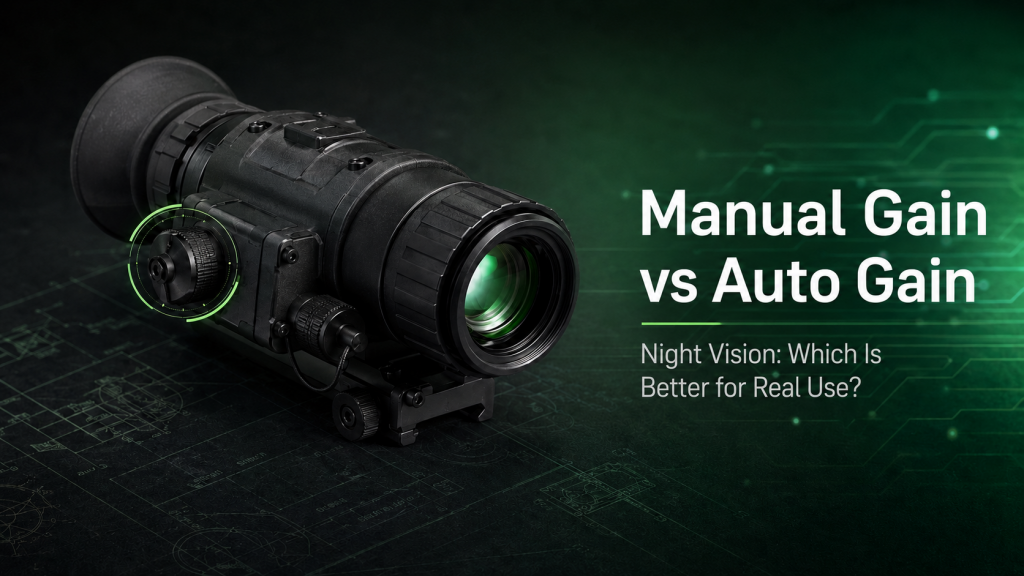
In night vision, “gain” refers to how much the image intensifier tube amplifies available light. A higher gain setting makes the image appear brighter. A lower gain setting makes the image darker and calmer to look at.
This matters because real nighttime environments are not always evenly dark.
You might be walking under trees, then step into an open field. You might look toward a building with lights, then turn back into a dark trail. You might be using an IR illuminator in one moment and natural starlight in the next.
In all of these situations, your device has to manage brightness somehow. That is where manual gain and auto gain come in.
Manual gain night vision lets the user adjust the image brightness by hand, usually through a control knob on the device.
Think of it like adjusting the brightness on a camera viewfinder or turning down the volume when something gets too loud. The tube is still doing the work of amplifying light, but you decide how bright the final image should feel to your eyes.
With manual gain, you can lower the brightness when the scene is too bright, reduce eye fatigue during long use, and tune the image for better comfort in mixed lighting.
This is one reason many experienced users like manual gain PVS-14 style monoculars. It gives them more control, especially when moving through changing environments.
Auto gain night vision adjusts brightness automatically. Instead of the user turning a knob, the device manages the image output based on the amount of light entering the tube.
For many users, this is simple and convenient. You turn the device on, focus it, and use it. There is no need to keep adjusting brightness as the environment changes.
Auto gain can be a good option for beginners, casual outdoor users, or anyone who prefers a simpler setup. It can also be useful when you want to focus on movement, navigation, or observation without thinking about settings.
However, auto gain does not always mean the image will look exactly how you personally want it. The device decides the brightness level for you. Most of the time that is fine, but in some situations, users may prefer more direct control.
The real difference is not just “manual knob or no knob.”
The real difference is control versus convenience.
Manual gain gives you more control over the image. Auto gain gives you a simpler experience.
If you use night vision for short sessions, basic outdoor observation, camping, property checks, or general low-light viewing, auto gain may feel easier. You do not need to think much about brightness control.
If you use night vision for longer sessions, helmet-mounted movement, training, tactical-style setups, or environments with mixed lighting, manual gain becomes more valuable. Being able to turn the brightness down can make the image more comfortable and reduce eye strain.
A common mistake is thinking brighter always means better. In night vision, that is not always true.
A very bright image can be useful in extremely dark areas, but it can also become tiring. When the screen is too bright, your night-adapted vision may suffer, and your eyes may feel stressed after extended use.
Manual gain gives you the ability to reduce brightness to a more natural level. This can make the image feel smoother and less aggressive, especially during long periods of helmet-mounted use.
For example, if you are walking through a forest trail and the image looks too bright because of snow, moonlight, nearby lights, or IR reflection, you can simply lower the gain. The scene may look less harsh, and your eyes may stay more relaxed.
That kind of fine adjustment is difficult to replace with automatic control.
Auto gain still has a strong place.
For many users, especially first-time buyers, the simplest device is often the device they will use the most. If someone is buying a night vision monocular mainly for outdoor observation, farm use, security checks, wildlife viewing, or general exploring, auto gain can be completely practical.
There is less to adjust, less to think about, and less chance of setting the image too low by mistake.
Auto gain is also convenient when you are handing the device to another person. They do not need to understand gain settings. They can simply look through the device and use it.
For casual users, that simplicity matters.
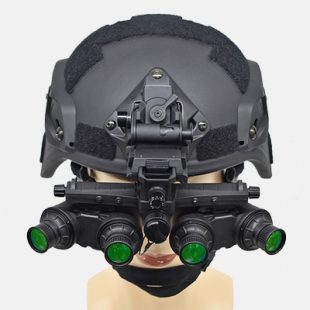
For helmet-mounted night vision, manual gain is usually more attractive.
When a device is mounted in front of your eye, comfort matters a lot. You are not just taking a quick look. You may be moving, scanning, walking, or using it for a longer session.
A bright image can become tiring. With manual gain, you can turn the image down to a comfortable level while still keeping enough detail to navigate.
This is especially helpful if you are moving between different light zones, such as open fields, tree cover, roads, buildings, or areas with IR reflection.
Auto gain can still work well, but manual gain gives you more control over how the image feels during extended use.
Neither system automatically guarantees a better image.
Image quality depends heavily on the tube itself: FOM, signal-to-noise ratio, resolution, phosphor type, blemishes, optics, and overall build quality.
A high-quality auto gain device can look better than a lower-quality manual gain device. A high-quality manual gain device can give both excellent image quality and more user control.
So do not buy based on gain control alone. Treat it as one part of the full night vision system.
If two devices have similar tube quality, similar optics, and similar build quality, then manual gain may offer the more flexible real-world experience.
Choose manual gain if you want more control, plan to use your device helmet-mounted, spend longer periods under night vision, or move through changing light conditions. It is the better choice for users who care about comfort, adjustment, and flexibility.
Choose auto gain if you want a simpler device that works with minimal adjustment. It is a practical choice for beginners, casual outdoor users, wildlife observation, property checks, and general low-light use.
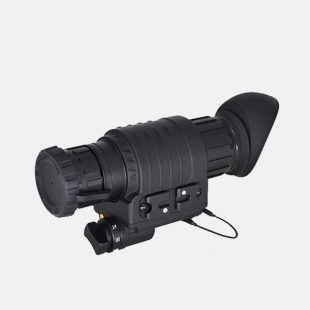
If you prefer manual control, the LinduNV LD-NVM18 PVS-14 Manual Gain Night Vision Monocular is designed for users who want a more adjustable viewing experience. It is a strong option for helmet-mounted use, outdoor movement, and users who want more control over image brightness.
If you prefer a simple setup, an Auto Gain Gen2+ PVS-14 Night Vision Monocular can be a better fit. It is easier to use, more beginner-friendly, and suitable for general outdoor observation.
Both choices can make sense. The key is to match the device to your real use, not just the spec sheet.
Manual gain is not automatically better, but it gives the user more control. For long sessions, helmet-mounted use, and mixed lighting, manual gain is often more comfortable. For simple observation, auto gain may be easier.
No. Auto gain does not mean poor quality. Tube quality, optics, FOM, SNR, and build quality matter more. Auto gain simply means the device manages brightness automatically.
Not always. Beginners can use auto gain very comfortably. However, if a beginner plans to build a serious night vision setup, manual gain may be worth considering from the start.
Yes. Manual gain is especially useful on a PVS-14 style monocular because many users mount it on a helmet and use it for longer sessions. Being able to lower brightness can improve comfort.
For casual outdoor use, auto gain is simple and practical. For longer outdoor movement, mixed lighting, or helmet-mounted use, manual gain gives more flexibility.