Recent Post
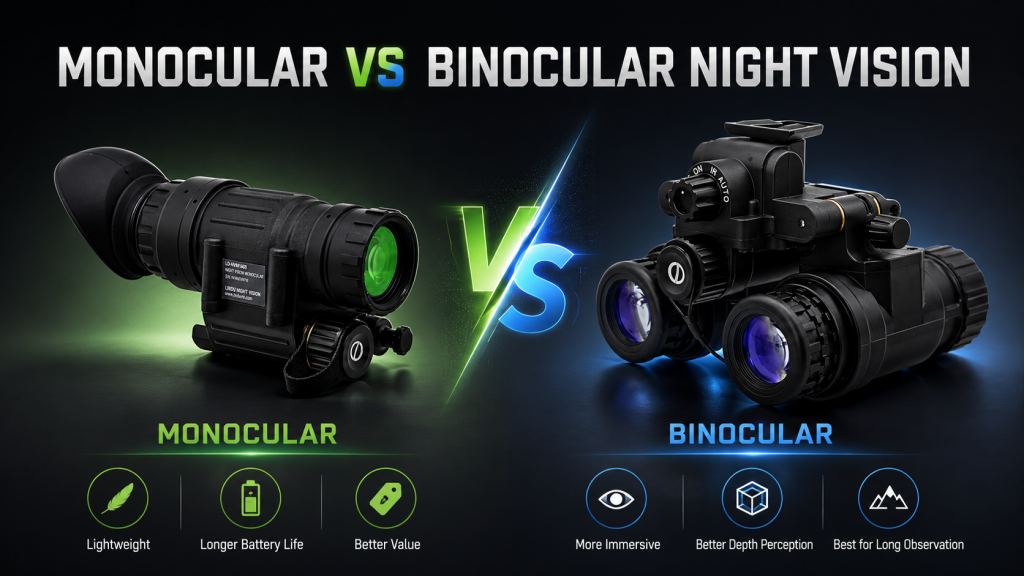
1️⃣Choosing your first night vision device can feel confusing, especially when you see both monocular night vision and binocular night vision products on the market.
Many beginners naturally assume that binocular night vision must be better because it looks more professional, uses both eyes, and often costs more. But in real use, the answer is not that simple.
A binocular night vision device is not always the best choice. A monocular night vision device is not necessarily “lower-end” either. The better option depends on how you plan to use it, how often you use it, your budget, and whether portability or viewing comfort matters more to you.
Whether you need night vision for camping, hiking, wildlife observation, farm security, property patrol, or outdoor night travel, choosing the right type will directly affect your comfort, viewing experience, battery life, and overall value.
The biggest difference is simple: a monocular night vision device is used with one eye, while a binocular night vision device is used with both eyes.
However, that does not mean the binocular model automatically gives you double the performance.
If the two devices use similar core components, such as the same image sensor, image intensifier tube, infrared illuminator, lens quality, and display technology, their basic night viewing clarity and detection distance may be quite similar.
The real difference is in how you experience the image, how comfortable the device feels over time, and how practical it is for your specific situation.
A monocular night vision device has a single viewing channel. You usually look through it with one eye while keeping the other eye open to observe your surroundings naturally.
This type of night vision device is popular among beginners because it is usually lighter, more compact, easier to carry, and more affordable.
Monocular night vision is often used for:
· Night camping
· Short outdoor walks
· Wildlife spotting
· Farm and property security
· Backup observation
· Entry-level night vision use
· For users who only need night vision occasionally, a monocular device is often enough.
A binocular night vision device allows you to observe with both eyes at the same time. It feels closer to natural human vision and usually provides a more immersive viewing experience.
This type of device is commonly used for longer observation sessions, head-mounted use, professional outdoor patrol, security work, and situations where comfort and depth perception are more important.
Binocular night vision usually feels more natural because both eyes are receiving a similar image. This can reduce visual fatigue and make movement in the dark feel easier.
That said, binocular models are usually heavier, larger, more expensive, and more power-hungry than monocular models.
①.Viewing Experience: Binocular Night Vision Feels More Natural
This is where binocular night vision has its biggest advantage.
Humans naturally rely on both eyes to judge distance, depth, and space. When both eyes receive a night vision image at the same time, the viewing experience feels more balanced and more comfortable.
With binocular night vision, it is easier to judge:
· Distance to objects
· Terrain changes
· Obstacles in front of you
· Movement in the surrounding area
· Depth and spatial awareness
This makes binocular night vision especially useful when you need to move around at night or observe for a long time.
So, if your top priority is a natural and immersive viewing experience, binocular night vision has the advantage.
②.Battery Life: Monocular Night Vision Usually Lasts Longer
Battery life is an important factor, especially when you are outdoors at night with no easy way to recharge.
Monocular night vision devices generally consume less power because they use fewer components. In many cases, one battery set can support a full night of casual use, depending on the model, infrared brightness, temperature, and display settings.
Binocular night vision devices usually consume more power. If the device uses two viewing channels, more display output, stronger processing, or additional illumination, battery consumption can increase.
For long outdoor use, you may need to carry spare batteries or an external power source. This adds weight and makes the setup less convenient.
For users who value longer runtime and simpler operation, monocular night vision often wins.
③.Price and Value: Monocular Night Vision Is Better for Most Beginners
Price is one of the clearest differences.
Under similar image quality and core specifications, binocular night vision is usually much more expensive than monocular night vision. The higher cost comes from the larger structure, more complex design, additional viewing components, and head-mounted comfort features.
But the actual night vision performance does not always double just because the price is higher.
For beginners, casual users, and people with a limited budget, a good monocular night vision device often offers better value. It gives you the core function you need: seeing in the dark.
Binocular night vision is worth considering if you use night vision frequently, need long-term wearing comfort, or want a more natural viewing experience.
But if you only use it occasionally, paying much more for binocular night vision may not be necessary.
Do not choose a night vision device only because it looks more professional or costs more. Choose the one that fits your actual use.
If this is your first night vision device, start with a reliable monocular model. It is easier to carry, easier to use, and usually gives you the best value for money.
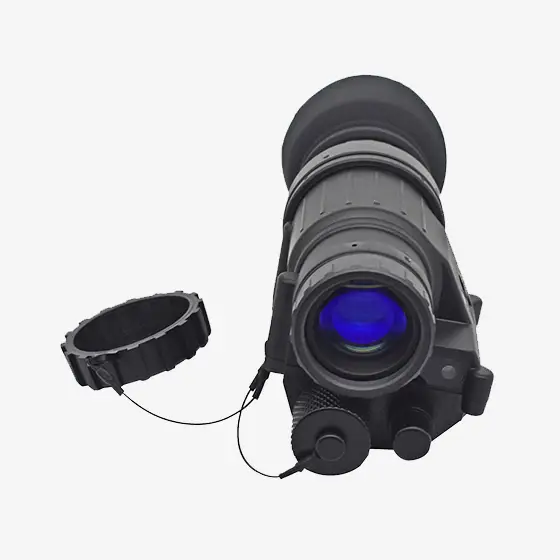
After you become familiar with night vision and know that you need longer observation time or a more immersive viewing experience, you can upgrade to binocular night vision later.
Choose monocular night vision if you want something lightweight, affordable, and practical.
Choose binocular night vision if you want better viewing comfort, stronger immersion, and a more professional experience.
The best night vision device is not always the most expensive one. It is the one that actually matches how and where you use it.